Imagine standing in Africa millions of years ago, holding a stone in your hand.
This scenario raises the question of how early humans developed intelligence, focusing on the importance of learning and cooperation.
There are no schools, books, or written material. No computers or phones to look things up on. All you know comes from experience, what you’ve seen, and what you’ve learned from others.
You take another stone and strike it against the first.
A sharp piece breaks off.
Suddenly you’ve got something useful, a tool which might be of use in cutting your food or working with other things.
It might seem like a minor discovery today. For our ancestors, the ability to make and use tools was a game changer.
Today we build aircraft and go to space.
They do brain surgery and create AI. How did early humans become intelligent? Through the power of learning and cooperation.
Yet the roots of our ability to invent things go back millions of years.
So how did our ancestors go from using stones to developing the intelligence that enables modern life?
In our previous article How Did the Human Brain Evolve? we looked at how the brain changed over time and how those changes may have enabled our ancestors to think, communicate, and work together.
Now let’s look at three of the key elements of that story: making tools, learning from others and sharing knowledge.
In particular, How Did Early Humans Become Intelligent? The Power of Learning and Cooperation covers this.
When Ordinary Stones Became Tools
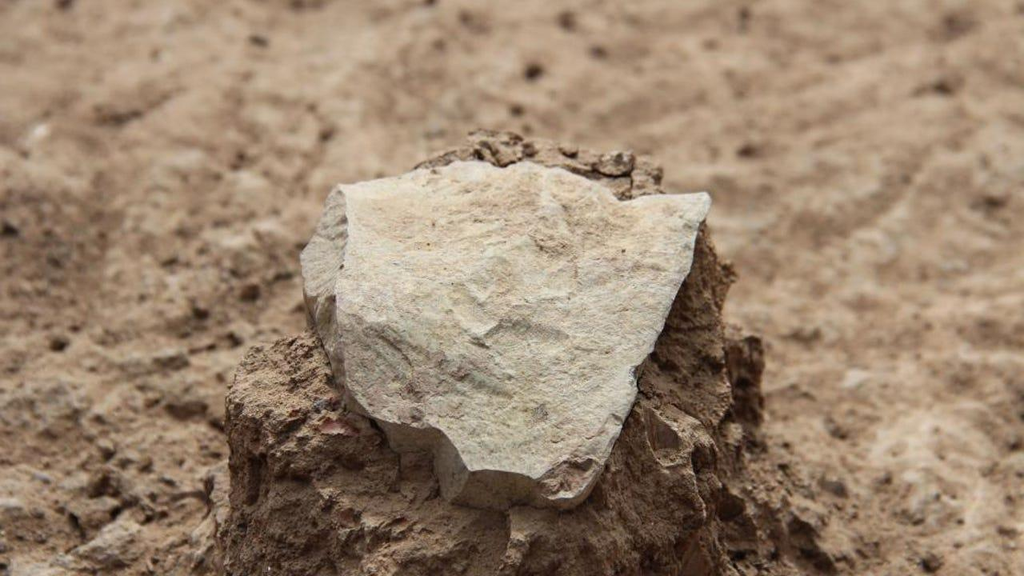
larazones Archaeological stone artefacts are used by scientists to investigate how our early relatives made and used tools so many millions of years ago.
Imagine living in a world where you must get almost everything you need directly from the land.
You need food, water and shelter. You need to look after yourself from dangerous animals and have to survive the changing of the weather.
Now imagine finding out that a sharp stone can make certain jobs easier.
You could use it to cut meat, to slice plants or to work with all sorts of other things.
That discovery could change the way you survive.
For a long time, the prevailing view held that the earliest stone tool tradition dated back about 2.6 million years.
Then something extraordinary occurred.
In Kenya researchers have found stone tools which are about 3.3 million years old.
The tools were found at Lomekwi 3 (near Lake Turkana in Africa).
Scientists reported the discovery in the journal Nature in 2015.
What made this discovery so significant?
The tools were older than the earliest Homo.
This implies that even the older human relatives could make tools.
Scientists still do not know exactly which species made them.
But the find changed our view of when tool making began.
It shows our ancient relatives found ways to work with their environment long before we thought.
Check out the first one: the 3.3 million-year-old stone tools from Lomekwi 3 in Kenya.
How Making Tools May Have Helped the Brain Develop
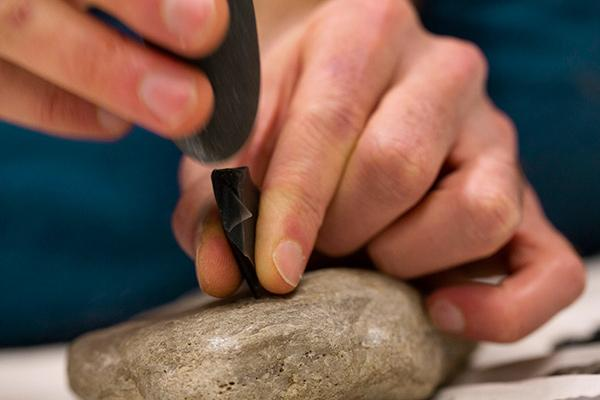
Have you ever tried learning something new?
Maybe riding a bicycle, cooking a meal, or fixing something around your home.
At first, you probably made mistakes.
But with practice, you got better.
A similar process happens when learning to make a stone tool.
Imagine striking two rocks together.
The first attempt doesn’t work.
The second attempt breaks the stone incorrectly. After several tries, you begin to notice something.
The angle matters.
The amount of force matters.
And the type of stone matters.
You learn through experience.
Making tools requires several important brain abilities.
You must pay attention, recall what worked before, and control your hand movements.
You may also need to think ahead about what you want the finished tool to look like.
Scientists have studied the brains of modern people while they make stone tools similar to those used long ago.
A study published in PLOS ONE examined which brain regions work together during early stone-tool-making activities.
The research showed that tool making involves connected brain regions responsible for movement and thinking.
Read the scientific study: The Functional Brain Networks That Underlie Early Stone Age Tool Manufacture.
Does thDoes that mean making tools caused the brain to develop?ecessarily.
Scientists believe many factors influenced brain evolution, including diet, changing environments, social relationships, and biological changes.
But making tools may have been part of that process.
Individuals who could learn useful skills and solve problems may have had advantages in certain environments.
Over many generations, those advantages could have influenced how our ancestors developed.
The key idea is that making tools required learning, attention, and decision-making—abilities that remain important.
But another ability may have been even more valuable.
Learning from someone else.
Why Learning From Others Changed Everything
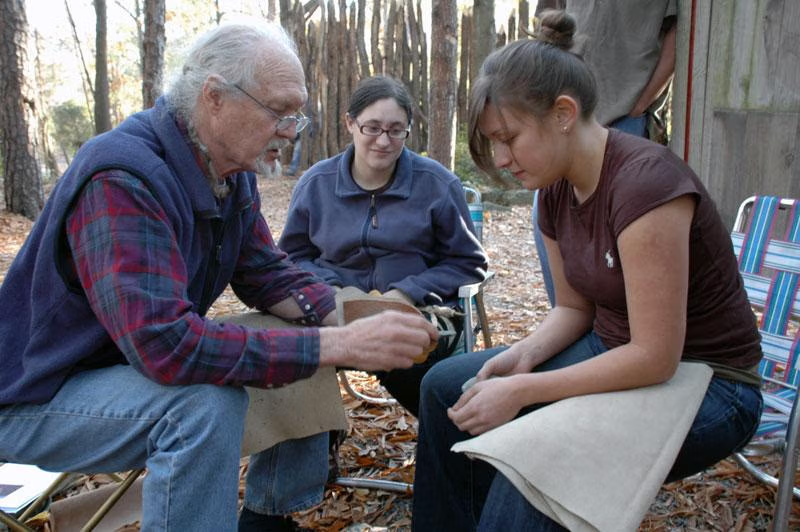
flintknappinghalloffame.blogspot.com Modern experimental archaeology shows how people can learn stone-tool-making techniques through observation and teaching.
Imagine two people trying to make a sharp stone tool.
One person has never seen it done before.
They try different methods, make mistakes, and spend a long time figuring out what works.
The second person watches someone who already knows how.
They observe how the stone is held, where it is struck, and how much force is used.
Who do you think might learn faster?
The second person has the advantage. They do not have to figure everything out alone.mselves.
Scientists call this social learning.
That means learning by watching, listening to, or interacting with others.
We do this every day.
Children learn by watching their parents.
Students learn from teachers.
Workers gain knowledge from experienced coworkers.
Even something as simple as watching someone cook a meal is a form of social learning.
Our ancestors could learn from one another, although scientists cannot know exactly how every ancient group taught skills.
In 2015, researchers published an experiment in Nature Communications.
They asked modern participants to learn how to make stone tools using different methods.
Some learned mainly by watching. Others received demonstrations or more direct instruction.
The researchers found that teaching, especially using words, helped pass on tool-making skills more effectively.
Read the research: Experimental Evidence for the Co-evolution of Hominin Tool-making Teaching and Language.
This does not prove that ancient toolmakers spoke the way we do today.
But it helps explain why communication and teaching were so valuable.
Think about what this meant for survival.
An experienced group member might know where to find water during a dry season.
Someone else might know which plants were safe to eat.
Another might know how to make a useful cutting tool.
When they shared that knowledge, other members of the group could benefit.
Instead of everyone discovering everything alone, people learned from others’ experience.
And that created an opportunity for something even greater.
Knowledge could begin to build among generations.
How Working Together Helped Human Knowledge Grow
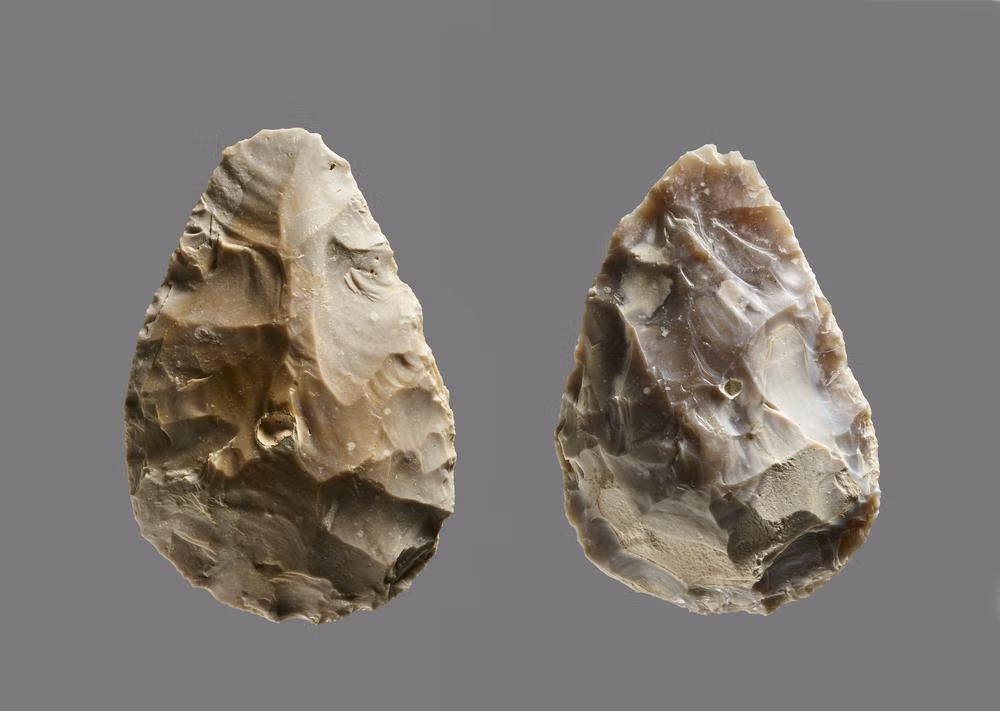
britishmuseum. org. Prehistoric stone tools preserved in museum collections provide evidence of how tool-making traditions changed over time.
Imagine someone discovers a better way to make a stone tool.
They show another person.
That person learns the method and eventually improves it.
Years later, someone younger learns the improved technique.
Now imagine this happening over many generations.
Knowledge can gradually grow.
Scientists call this cumulative cultural evolution.
That sounds complicated, but the idea is simple.
It means knowledge builds over time because people learn from earlier generations and sometimes improve on what they learned.bout a bicycle.
The bicycles we use today were not created perfectly in a single day.
Different people developed and improved designs over many years.
The same is true of computers, medicine, farming, and countless other inventions.
People learn from discoveries made before they were born.
Our ancestors could also pass along useful knowledge, even though their technologies were much simpler.
But there was another important factor.
People needed opportunities to connect with one another.
Imagine two communities.
One group rarely interacts with anyone outside its small community.
The other regularly meets different groups and exchanges useful information.
The second community may have more opportunities to discover new ideas and learn skills.
Scientists have studied how population size and connections between groups might have influenced cultural development.
A 2009 study published in Science explored whether population growth and contact between groups could help explain why certain advanced behaviors became more common during parts of human history.
Read the research: Late Pleistocene Demography and the Appearance of Modern Human Behavior.
This is one explanation, and scientists are still investigating it.
But the bigger lesson is important.
A useful discovery can disappear if nobody learns it.
When people share and remember knowledge, it has a better chance to survive.
Working together helped our ancestors do more than survive. It gave communities chances to preserve and build on what others had learned.
Intelligence Has Never Been Only About Having a Bigger Brain
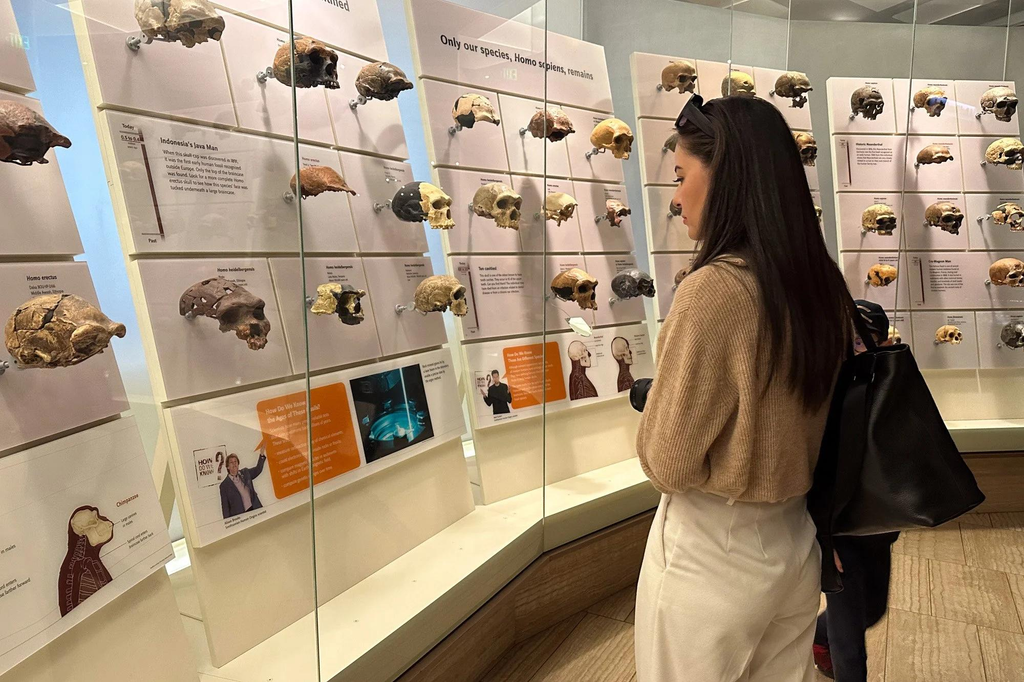
thetravelpockets.comReal fossil skulls and museum casts help researchers study our evolutionary relatives. Human evolution was a branching process, not a straight line.
When people think about human evolution, they sometimes imagine our ancestors developed bigger brains until modern humans emerged.
But the story is much more complicated.
Evolution is not a straight line.
Many different human relatives lived at different times, sometimes alongside one another.
Each species faced its own challenges.
Having a larger brain does not automatically mean being better at all kinds of thinking.
Consider this example.
Imagine an early human who knows how to find water during a drought.
They remember the landscape, recognize signs of changing weather, and understand where animals travel.
Those abilities could help keep their group alive.
Now imagine someone who is skilled at recognizing when another individual is angry, frightened, or willing to cooperate.
That ability could also be extremely valuable.
Intelligence includes many different skills.
It involves remembering, learning, making decisions, recognizing patterns, and responding to problems.
Scientists can study ancient skulls and tools but cannot directly observe every thought or behavior of people who lived hundreds of thousands or millions of years ago.
Many activities, such as speaking, gesturing, or working with materials that decay, leave little evidence.
This means we still know very little.
Our ancestors did not need computers or modern schools to show intelligence.
They needed abilities that helped them live in their environments.
The Beginning of Something Exceptional
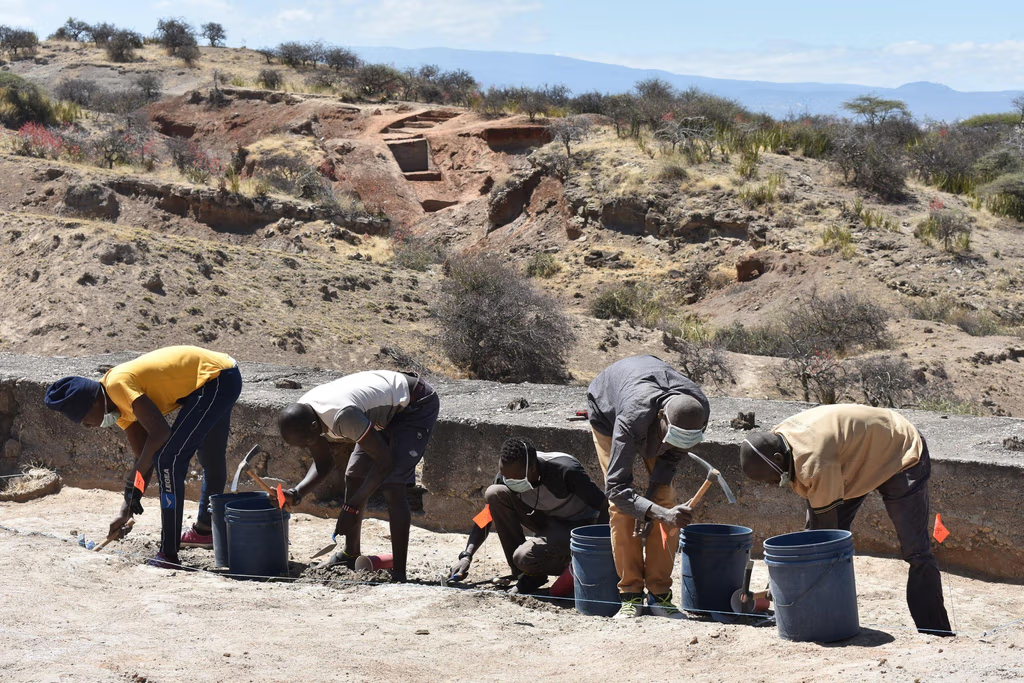
scitechdaily. com. Archaeologists studying ancient sites carefully examine tools and other remains to reconstruct how early humans lived. Artifacts survive even when most everyday activities leave no trace.
Over millions of years, our ancestors developed different ways of solving problems.
They made tools.
They learned from experience.
They observed others.
And they shared useful knowledge within their groups.
These changes happened slowly.
No single day marked when humans suddenly became intelligent.
Different groups developed different skills and traditions.
Some techniques disappeared. Others lasted for long periods. People sometimes invented new methods independently in different places.
Human intelligence developed over a long history shaped by the brain, environment, and relationships between individuals.
That is what makes this story so remarkable.
A stone tool may look simple today.
But it can tell us something about an ancient individual’s ability to interact with the world.
When useful knowledge was shared, it became part of something larger.
Culture—the ideas, skills, and traditions that people learn and pass along.
What Our Ancestors Can Teach Us About Intelligence Today
Think about the difference between an ancient stone tool and a modern computer.
One is a piece of rock shaped by hand.
The other is a machine built using knowledge from many fields of science and engineering.
They may seem unrelated.
Both represent our ability to use knowledge to solve problems.
The computer on your desk did not come from a single person’s discoveries.
It depends upon generations of learning, experimentation, and shared ideas.
The same is true of the language you speak, the medicine you use, and the buildings you live in.
Human achievements often depend on knowledge that was developed long before we were born.
Our ancestors helped establish the foundations of this process.
They learned from their surroundings, shared useful skills, and found ways to face challenges together.
This raises another interesting question.
If learning from others was so important, how did humans develop the ability to communicate complicated ideas?
Watching someone make a tool can teach you a physical skill.
But language allows us to do much more.
We can explain something that happened yesterday.
We can describe a place we have never visited.
We can warn others about dangers they cannot see.
We can tell stories about the past and imagine what might happen tomorrow.
How did humans develop this extraordinary ability?
That is where our journey continues.
Questions to Explore Next
As we continue exploring human origins, consider these three questions:
- How did humans develop spoken language, and how can scientists study something that leaves no fossils?
- How did communication help early humans work together and teach one another?
- How did language let humans share stories, remember the past, and imagine the future?
We’ll explore these questions in the next article of our Human Origins Series.
Coming Next: How Did Humans Learn to Speak? The Evolution of Language and Communication
Scientific Research & Further Reading
Want to explore the discoveries behind this article? These studies give a deeper look at what scientists have learned.
- Harmand et al. (2015) — 3.3-Million-Year-Old Stone Tools from Lomekwi 3, Kenya. How scientists discovered evidence of very early tool-making.
- Stout et al. (2013) — Brain Networks Involved in Early Stone Toolmaking. How researchers study the brain activity involved in making ancient-style tools.
- Morgan et al. (2015) — How Teaching and Language Help People Learn Toolmaking. An experiment exploring how people learn practical skills from one another.
- Powell, Shennan & Thomas (2009) — Population Growth and the Development of Human Culture. Research investigating how social connections and population size may have influenced cultural development.
Continue Exploring Human Origins
Our journey into human history doesn’t end here. Each article builds on the last, helping you understand how our ancestors developed the abilities that shaped the world we live in today.
Continue to the next article to discover more, or revisit the previous article to connect what you’ve learned.